Flora
Elder Tree: The Grandmother Guardian
“It has been said, with some truth, that our English summer is not here until the Elder is fully in flower, and that it ends when the berries are ripe.”
Maude Grieve, Modern Herbal, 1940
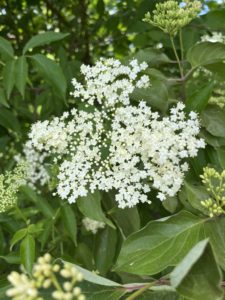
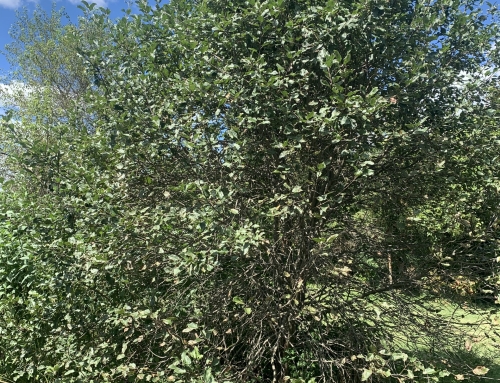
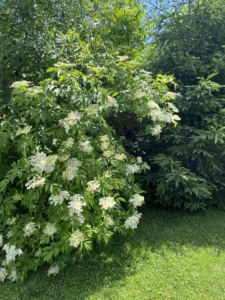
As we approach the Autumn Equinox, the elderberries have been made into syrup and I am reminded of how the small but mighty Elder trees are guardians of our gardens and of our health. Often growing in the wild amongst the hedgerows, they like the wetness of ditches and being on the edges.
Elder is a boundary tree; she gaurds the boundaries between life and death, between sickness and health, between this world and the otherworld. Like any transition point, this can be a dangerous road to travel, but can also lead to rich rewards. – Dana O’Driscoll
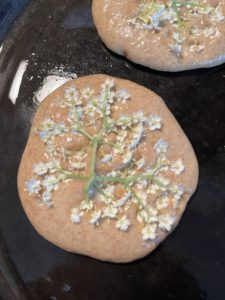
At the sanctuary, the elders are part of our windbreak areas, protecting our other garden plants. In the late spring / early summer, we harvest the flowers to use in making elderflower pancakes or fritters. The flowers are what later will become the berries, so we only harvest some of them and make sure to leave many for the berries to come. Elderflowers can also be used in making cordials or dried for use in medicinal tea, being particularly good for modulating the type of fever where a person feels agitated and isn’t sweating. It is a relaxing diaphoretic which encourages the capillaries to open up and the heat to be dispelled. It can also be used in salves, creams and washes for skin irritations. The energetics of elder is cooling and drying.
Elder has long been associated with the crone, and I see her as a protective grandmother to be revered and respected for her great strength. She is known to have transformative powers both with death and rebirth, and thus her magic requires caution and wisdom which I will expand on more below. The astrological sign of elder is linked to Sagittarius, which is the time of year when the sun is dying and being reborn. This theme of regeneration is further seen through the aspect that a branch broken from an Elder can easily take root and regrow.
In the late summer, the berries can be used in many different ways – jam, syrup, wine, pie, sparkling juice… there are many options. At the sanctuary, we only harvest the berries we can reach, leaving the rest for the birds and wildlife. One of the things I love about elder is that it is the perfect “food as medicine” plant. The syrup can be used as a tonic for staying healthy. Taking a spoonful each day as a preventative, or at the onset of detox type symptoms taking a spoonful several times throughout the day to lessen the duration of symptoms are typical ways to use it medicinally.
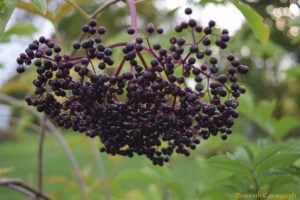
The syrup is also delicious to use on pancakes, and the recipe we use preserves it well with honey and can last through the year in the refrigerator. So a particular delight is being able to use the last of the year’s syrup on the elderflower pancakes of the following year.
Elder is a plant that does require care in working with because not knowing the finer details can lead to some bad effects. For example:
Elder wood has a pithy center. This easily hollowed out center allows for the creation of various tools and instruments, such as flutes or blow guns or pipes. Have some caution though: the pithy center of elder contains cyanide-producing glycosides that, when consumed in quantity, can cause a variety of problems, including death. Drying or boiling the materials makes them safer to use. – Rosalee de la Forêt
So having caution with the different parts of the plant being used and the stages of ripeness is important. But working with this powerful grandmother is indeed highly rewarding and well worth learning her secrets.
And elderberry I have learned to call it.I love its blooms like saucers brimmed with meal,Its berries a swart caviar of shot,A buoyant spawn, a light bruised out of purple.Elderberry? It is shires dreaming wine.– Seamus Heaney
Share this article
Written by : Jean Cavanaugh
Jean Cavanaugh is the founder and steward of Crossing Hedgerows Sanctuary, established in 2019 as a living, learning community devoted to reconnecting people with the wisdom of nature, the sacred order of creation, and the presence of Christ within all life. Her work brings together spiritual formation, ecological stewardship, ancestral wisdom, and hands-on community practice.
Through years of practical work on the land, study of the Mysteries, and the healing of her own severe health challenges through natural methods, Jean has come to recognize God’s hand at work throughout creation. Her teachings, rooted in the Mystery School tradition and Christian gnosis, explore how the patterns of heaven, earth, and the human body reveal the way back to divine presence, peace, and inner strength.
Jean leads with honesty, integrity, and a deeply welcoming spirit, inviting others to let go of inherited assumptions and rediscover truth through lived experience and embodied understanding. She works with all ages—from preschoolers to elders—offering programs and celebrations that emphasize direct engagement with nature, music, story, homesteading skills, and in-person community.
She and her family live at the 21-acre Crossing Hedgerows Sanctuary, where daily life reflects a commitment to simplicity, beauty, and harmony with the land. The sanctuary includes gardens, woodland trails, a seasonal creek, gathering circles, and spaces designed to nourish both people and wildlife. Jean is especially passionate about creating environments that are grounding, beautiful, and spiritually restorative.
Through her writing and teaching, Jean encourages others to know themselves, know creation, and recognize Christ as the living truth present within and around us—always inviting a return to love, beauty, and the sacred order of life.