Flora
Hazelnuts
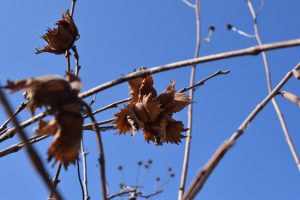
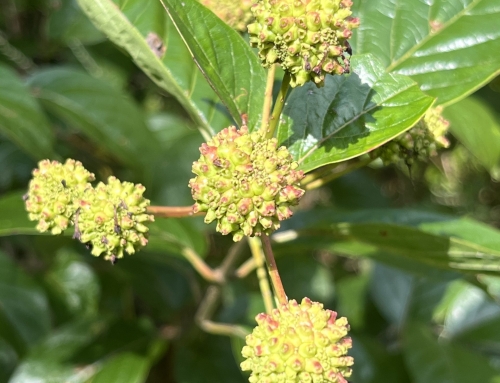
Look carefully for the nuts inside the “wrappers”
The photos I’m sharing today are from a hazelnut harvest we did last February. This is the time of year when they’re ready, but in our experience you can collect them anytime you get around to it, as long as the squirrels don’t beat you to it.
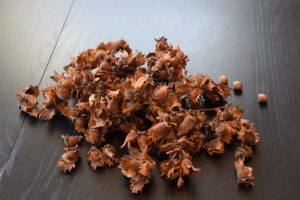
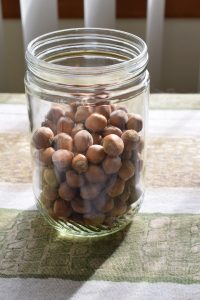
Our hazelnuts are the wild, native variety which are smaller than cultivars, but their taste is marvelous. Here is a write-up on hazelnuts done by Solomon Doe of Indigenous Landscapes:
Common Hazelnut (Corylus americana) – Once dominant, now fading towards functional extinction – Here’s how to Restore it
Common Hazelnut is one of the most important species of native thickets within grasslands and savannas. These large shrubs grow in as dry as soil as rocky glades and sandy savannas, or as wet as soil as wetland edges. They can grow in partial sun, but produce more nuts in full-sun. The fall color ranges from oranges to copper to pinks and greens depending on the condition it’s in. They are one of the highest shrubs in the amount of moths/butterflies that use them as host plants (131-known). Hazelnuts have high potential in Native Plant Agriculture. Compared to all types of food, they have a calorie density only less than hickory nuts like pecans, walnuts, and whale lard or other pure animal fat products. With the cultivating of American Hazelnuts achieved by Native Americans mostly lost, for agricultural purposes the yields are variable in size and quantity, so they will require some breeding to create high production agricultural crops. But for wildlife, any locally or regionally sourced American Hazelnut will do. We recommend that you get as regionally local of source as possible, as we’ve observed that non-local genotype can struggle to set nuts possibly because the cross pollination is effected by our climatic transplanting (buying plants from other slightly different climates).
Hazelnuts were a major component of thicket communities that coexisted within prairies and and savannas; though native thickets do not get nearly the restoration attention that wildflowers and grasses of these ecosystems get. Colonialism lead to the ending of large scale Native American land management practices throughout the range of the Native Hazelnut. Hazelnuts and other native thicket species were burned and ripped from grasslands and savannas in favor of pasture for cattle and for agricultural fields. At this point thicket species had to migrate to artificial man-made edges. While Hazelnuts are recorded in nearly every county of Ohio, it has been largely erased from the natural environment specifically where invasive plants such as Autumn Olive and Amur Honeysuckle have now taken the edges and open habitats native thicket communities depended upon to reproduce in. This is why many native thicket species formerly of grasslands and savannas are fading towards functional extinction, which is the point at which the population of a plant or animal is at too low of a number to significantly contribute to the ecology of a region.
How to Restore Native Hazelnuts (process also works for Beaked Hazelnut)
When you find one of these species, use a method we call “From collection until Spring” which describes how long the seeds will Stratify. There’s no need to de-husk hazelnuts. Place then in a well aerated mouse proofed container with silty soil soon after collecting the husks/nuts. Leave it outdoors all throughout late summer/fall/winter, with the container buried halfway into the ground or into mulch. In late winter, separate the seeds from the silty soil through straining them with the water pressure from a hose – washing the silty soil away leaving just the seeds behind. Sow the seeds into individual pots with proper amounts of fertilizer and potting soil. Grow them within a Chicken Wire enclosure to prevent squirrel damage. You may have to control mice and chipmunk populations if they find what’s in your chicken wire enclosure; as such is the inevitable conflict of growing native nut species. Plant your resulting hazelnut saplings in the fall in open fields, meadows, or prairies that are mowed at least once a year to prevent forest succession. Plant in large clusters to form continuous/least-fragmented thicket habitat within the field/meadow/prairie.
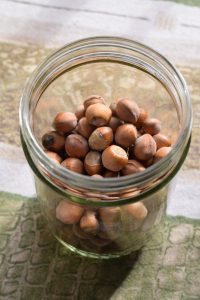
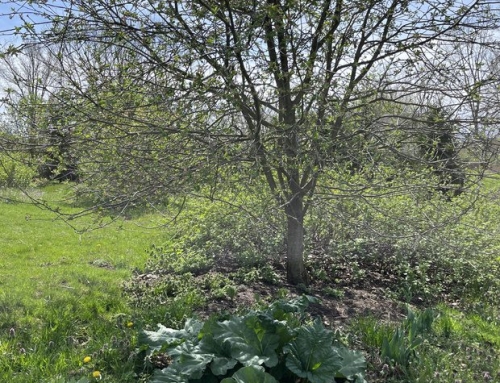
We have planted one hazelnut bush, and since then have found another one growing in our woods. We’re hoping to grow more at the Sanctuary to help propagate this endangered and important shrub.
Feel free anytime you come out, to request to see any particular plants or features you’re interested in seeing.
Happy hazelnut hunting!
Jean
Share this article
Written by : Jean Cavanaugh
Jean Cavanaugh is the founder and steward of Crossing Hedgerows Sanctuary, established in 2019 as a living, learning community devoted to reconnecting people with the wisdom of nature, the sacred order of creation, and the presence of Christ within all life. Her work brings together spiritual formation, ecological stewardship, ancestral wisdom, and hands-on community practice.
Through years of practical work on the land, study of the Mysteries, and the healing of her own severe health challenges through natural methods, Jean has come to recognize God’s hand at work throughout creation. Her teachings, rooted in the Mystery School tradition and Christian gnosis, explore how the patterns of heaven, earth, and the human body reveal the way back to divine presence, peace, and inner strength.
Jean leads with honesty, integrity, and a deeply welcoming spirit, inviting others to let go of inherited assumptions and rediscover truth through lived experience and embodied understanding. She works with all ages—from preschoolers to elders—offering programs and celebrations that emphasize direct engagement with nature, music, story, homesteading skills, and in-person community.
She and her family live at the 21-acre Crossing Hedgerows Sanctuary, where daily life reflects a commitment to simplicity, beauty, and harmony with the land. The sanctuary includes gardens, woodland trails, a seasonal creek, gathering circles, and spaces designed to nourish both people and wildlife. Jean is especially passionate about creating environments that are grounding, beautiful, and spiritually restorative.
Through her writing and teaching, Jean encourages others to know themselves, know creation, and recognize Christ as the living truth present within and around us—always inviting a return to love, beauty, and the sacred order of life.