Musings
Lughnasadh Celebration Discussion
The gods and goddesses tell us about eternal truths. We can see these truths in the ancient myths told about the constellations and the movements of the luminaries, as well as within our own bodies and lives, and the events of the world around us. The mythology found regarding the heavens and its relationship to earth and people are timeless tales which tell the same stories in different ways throughout time amongst a multitude of cultures. Our ancestors knew the stars intimately and these same stars and luminaries have never changed their positions or their set paths over the millennia. The stories they tell continue on, night after night revolving over our heads.
Over the years, we have celebrated the Gaelic festival of Lughnasadh at the beginning of August. It is a harvest festival honoring the Gaelic god Lugh. Lugh is a god of light and fire. He is an enlightened being in the same way as Odin and Jesus. When Odin hung upside down on the Yggdrasil tree of life, this was his rebirth, coming into his new life just as we are born from our mother’s womb, head first. This is also what is depicted on The Hanged Man card in the Tarot deck. Odin went through a rite of passage looking down into the waters for nine days until he discovered the magical rune letters. It is the story of his achievement of enlightenment.
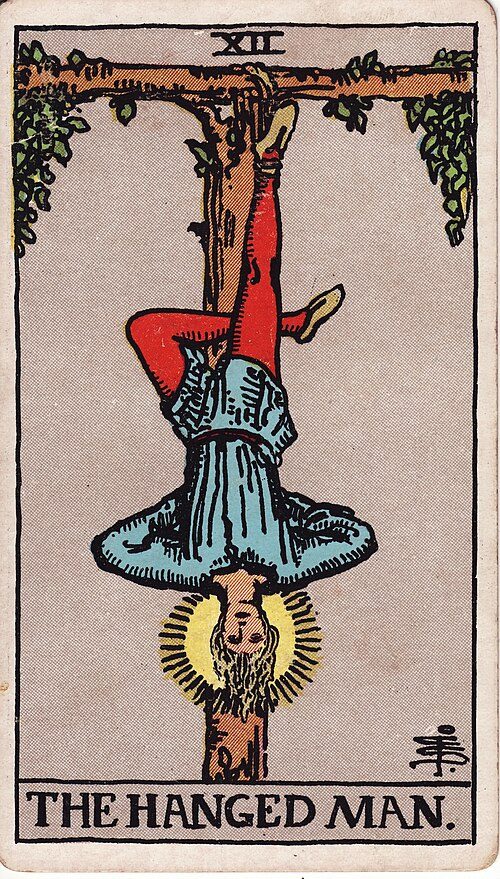
The hanged man – the halo around the head represents enlightenment.
In the same way, our own language is just as magical as the runes, and is encrypted with the mysteries written in the King James Version of the Holy Bible. We have largely lost and forgotten this knowledge of the magic within our own English language and culture. The cross which Jesus hung on is also a representation of the tree of life. It is the same as Leonardo Da Vinci’s Vitruvian Man, and the Kabbalistic tree of life which has a cross within the center of it.
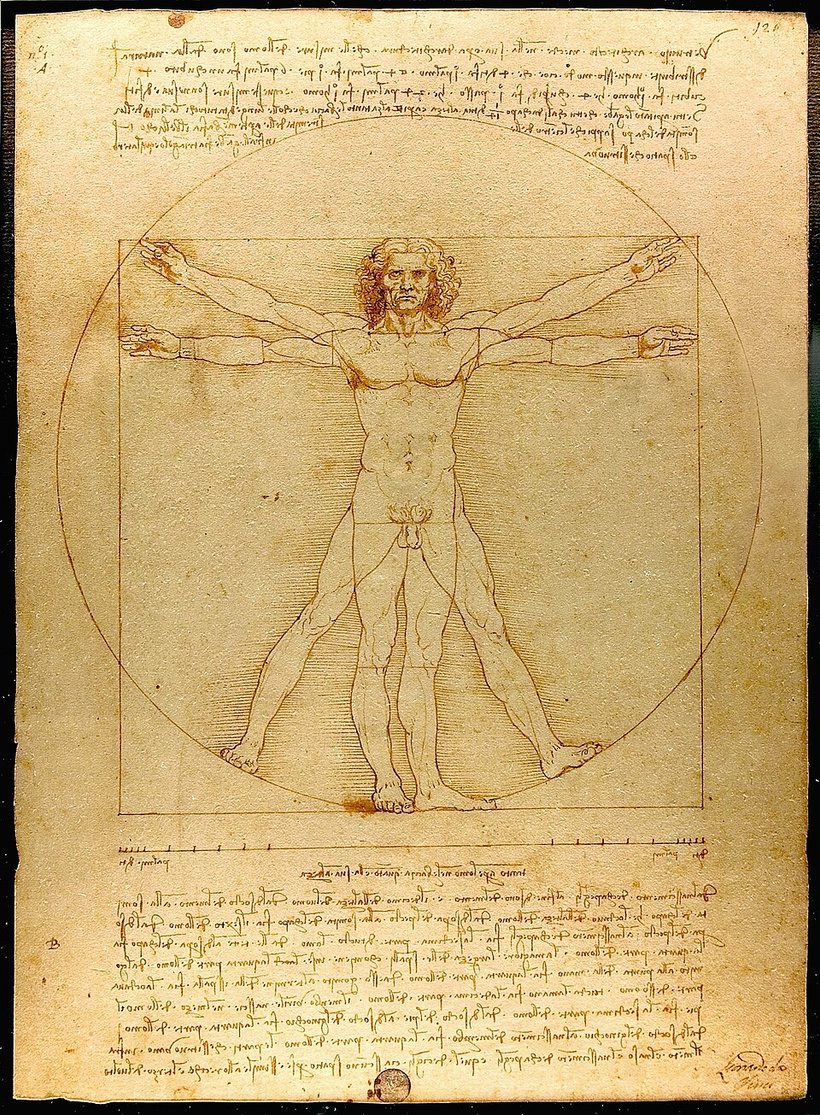
Leonardo Da Vinci’s Vitruvian Man
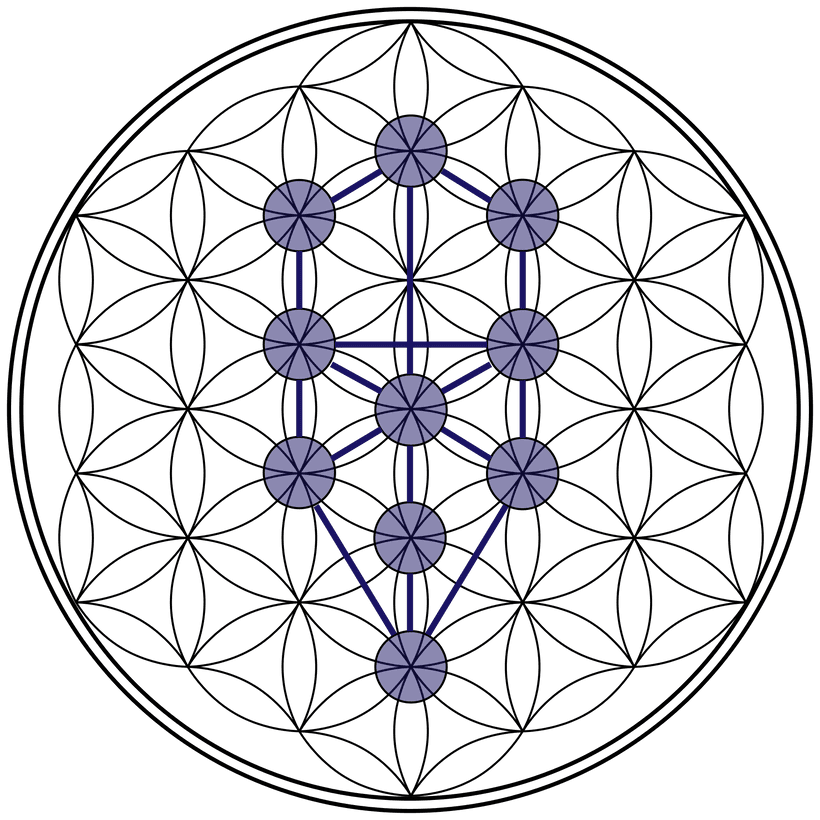
Kabbahlist Tree of Life within the Flower of Life
Jesus is the Vitruvian Man hanging on the tree of life. Within the stories of the Bible, his death and rebirth shows us the way we must all travel to spiritual rebirth and enlightenment. (I am only touching on a very small portion of what could be talked about with all this symbology to give you a taste of how they link up.)
With the study of sacred geometry, as shown in the images above, we can find truth that no-one can dispute, as it is written in the metaphysical language of nature (that being math), which only can come from God. No person made up math. The number three has always been three and will always be three. It is a language for understanding nature, and thus it is God’s language.
And once you begin to see how all languages are encrypted with mathematical codes, it makes you wonder if even languages were created by humans. At the very least, there were people in ancient times who were more brilliant than all of us put together. This is what you realize when you begin to get a glimpse of what we have lost in today’s world. These were also the people who built the cathedrals – the likes of which we have no idea how to build today.
So as we study the mysteries, we find that nature and the language of math always points to a creator because it is completely ordered to a point that the truth becomes indisputable. And the Bible is actually trying to get us to look outside into nature to find these truths.*
And so are the myths of a myriad cultures throughout time and in every corner of the Earth.
The time of Lughnasadh is a time of the beginning of reaping – of revelling in the height of summer, and yet of recognizing the reality of death-in-life – for soon Autumn will come, and with it darkness and the cold. So it is a time of rejoicing, but also of preparation for times ahead.
The theme of sacrifice is important at this time, and Lugh undergoes death and rebirth in a sacrificial mating with the Goddess, which shows the intimate connection recognized in these festivals between human fertility and the fertility of the land. The corn (wheat) is cut down and is reborn as the loaf of bread. Robert Graves says: ‘the Anglo-Saxon form of Lughomass, mass in honor of the God Lugh or Lew, was half-mass, ‘loaf-mass’, (Lammas), with reference to the corn-harvest and the killing of the Corn-king.’ This is the time when the god both dies and releases his seed, to be reborn again — the time depicted in the Story of Taliesin when Gwion ‘dies’ as a seed swallowed by the goddess Ceridwen — leading to his rebirth as Taliesin.
~ From The Order of Bards Ovates and Druids, Lughnasadh ceremony booklet
It is easy to see how this also represents the literal seeds going into the Mother Earth and being reborn as new plants. Because all of life on Mother Earth and in Father Sky is showing us the way to remember who we are and where we came from. That we are all a piece of this universal one-ness and must ultimately get off the wheel of time to find our way home to God. This means finding that peaceful, still place in the center of us, which corresponds to that peaceful and still place in the center of the heavens called the North Star. Knowing truth and knowing ourselves allows us to know God.
The story of Taliesin, the great Brittonic poet and bard, will be re-enacted as part of our next celebration of Lughnasadh. Lugh himself is the main Celtic deity of Light.
By August, the sun’s warmth and strength has matured the growing crops, so that by now the first fruits of the harvest appear, even as the nights grow longer than the day. The festival of Lughnasadh celebrates these first signs of a successful partnership between the Sun and the Earth…
The festival stands at the centre of the light half of the year, which began at Beltaine and ends at Samhain. It is dedicated to the god Lugh, who, in Irish mythology, stands out as a tribal and cultural hero. He was known as Samildánach, the Many-skilled One, who brought his tribe many useful gifts, including the secrets of agriculture. Another name for him was Lugh Lámhfhada, Lugh of the Long Arm, which could refer to the ray of the sun. The Romans equated him with Mercury whom they called ‘the inventor of all arts.’
~ From The Order of Bards Ovates and Druids, Lughnasadh ceremony booklet
Mercury, Hermes, Odin, King Arthur and Jesus are all really the same concept. I would add Lugh to this list. This does not belittle any of them. It tells us that what they show is the same message which is the Way and brings us true gnosis and God. There is so much more that could be said on this topic, but I hope it whets your appetite to learn more.
I am considering planning a Lughnasadh celebration for August 9th at 5 pm. Please reach out to me if you would like to attend so I can know if there is enough interest! You can message here on Patreon, or email crossinghedgerowssanctuary@gmail.com. If there are only a couple of us, I may plan a more simple ceremony to still be able to celebrate together.
Much love to all,
Jean
*The very best teacher I’ve found to learn about the Mysteries, is Marty Leeds of the Gnostic Church and Academy of Lord Jesus Christ.
Share this article
Written by : Jean Cavanaugh
Jean Cavanaugh is the founder and steward of Crossing Hedgerows Sanctuary, established in 2019 as a living, learning community devoted to reconnecting people with the wisdom of nature, the sacred order of creation, and the presence of Christ within all life. Her work brings together spiritual formation, ecological stewardship, ancestral wisdom, and hands-on community practice.
Through years of practical work on the land, study of the Mysteries, and the healing of her own severe health challenges through natural methods, Jean has come to recognize God’s hand at work throughout creation. Her teachings, rooted in the Mystery School tradition and Christian gnosis, explore how the patterns of heaven, earth, and the human body reveal the way back to divine presence, peace, and inner strength.
Jean leads with honesty, integrity, and a deeply welcoming spirit, inviting others to let go of inherited assumptions and rediscover truth through lived experience and embodied understanding. She works with all ages—from preschoolers to elders—offering programs and celebrations that emphasize direct engagement with nature, music, story, homesteading skills, and in-person community.
She and her family live at the 21-acre Crossing Hedgerows Sanctuary, where daily life reflects a commitment to simplicity, beauty, and harmony with the land. The sanctuary includes gardens, woodland trails, a seasonal creek, gathering circles, and spaces designed to nourish both people and wildlife. Jean is especially passionate about creating environments that are grounding, beautiful, and spiritually restorative.
Through her writing and teaching, Jean encourages others to know themselves, know creation, and recognize Christ as the living truth present within and around us—always inviting a return to love, beauty, and the sacred order of life.